
Willing Is Not Choosing
Why 2,300-Year-Old Philosophy Still Explains Modern Product Design


Aristotle writes in Nicomachean Ethics that “it seems, as we said, that what is chosen or purposed is willed, but that what is willed is not always chosen or purposed.” With this single line, Aristotle draws a precise boundary between desire and deliberate choice.
We will many things. Health, happiness, wisdom, success, a better life. These are genuine desires. They feel right, and we often mean them sincerely. But wanting something does not mean we have chosen it in any concrete or actionable way.
Choice only appears when the will passes through reasoning. It requires deliberation about how to act, when to act, and by what means. Choice is practical and specific. It commits you to doing something, not just valuing it.
A simple life example makes this clear. Many people genuinely want to be healthy. They value health, admire discipline, and even feel guilty when they fall short. But this remains at the level of will. Choice only enters when that desire is translated into a concrete decision: waking up at 6:30 to walk for thirty minutes, preparing meals in advance, or turning down late-night scrolling because tomorrow’s energy matters more. At that point, health is no longer an abstract good you agree with. It becomes a set of actions you have committed to, even when motivation fades. That is the difference between wanting a better life and actually choosing one.
This is Aristotle’s core point:
Everything we choose is something we will.
But not everything we will is something we actually choose.
You may will to be virtuous, educated, or healthy. But unless you choose the daily practices that make those things real, nothing changes.
This is why Aristotle ties character to repeated action. A life is shaped less by what we admire or intend, and more by what we deliberately choose when effort, discomfort, or sacrifice is required.
Let’s take another look from the modern perspective.
Product design works the same way. Teams often will outcomes like “better usability,” “delightful onboarding,” or “strong retention.” These intentions are real, but they remain abstract. Design begins only when those desires turn into choices. What do we remove? What friction do we accept? What do we prioritize when time and resources are limited?
A product is not defined by what a team hopes users will experience, but by the decisions it makes under constraint. Every flow, error state, and default setting is a choice. In that sense, design is ethics made visible. It reveals what was actually chosen, not what was merely intended.
Aristotle would say character is formed by repeated choices. Products are no different. Their character emerges from the accumulation of small, deliberate decisions made day after day.
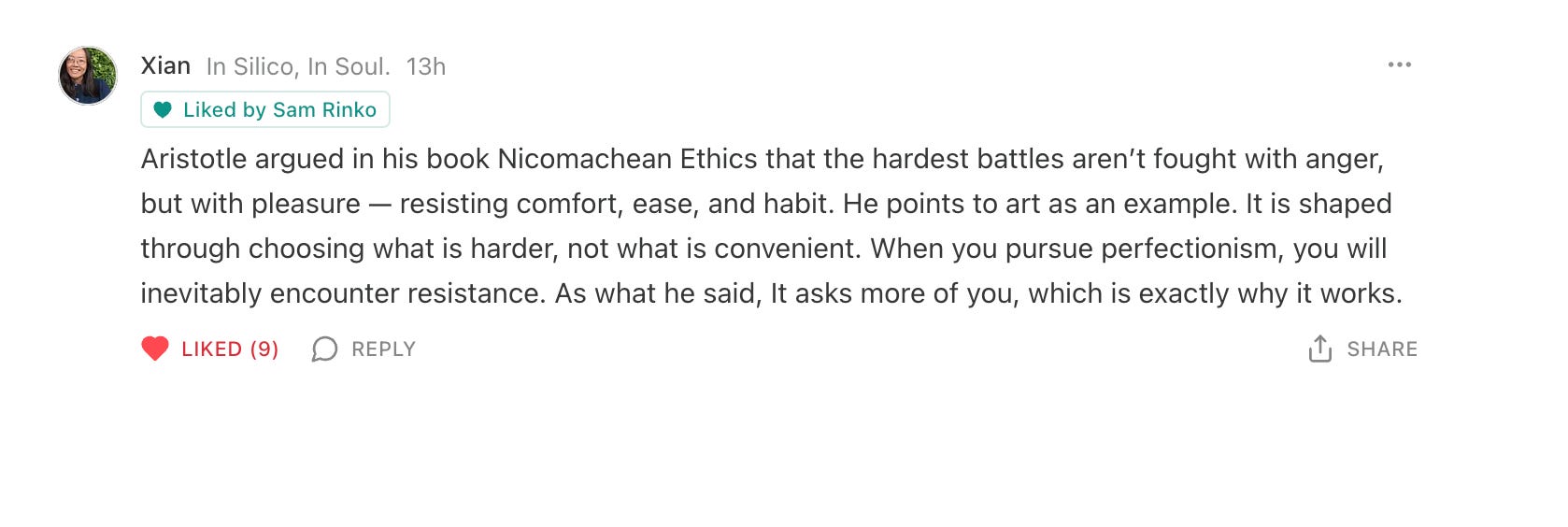
Since I started reading his book, I’ve begun to see many things with a completely fresh eye. Yesterday, I read an article and found myself leaving a comment, not just reacting instinctively, but thinking more carefully about what was actually being said and why it mattered.
I am about halfway through Nicomachean Ethics, and this is my first time reading it. I cannot believe how modern these ideas feel, despite being written over 2,300 years ago. I am thinking of starting a weekly or monthly series to reflect on them through the lens of product and design. Let me know in the comments if you would like to read more.
I am building a SaaS tool called Mermaid Mind, it converts YouTube videos into mind map diagrams and pill tags. It’s designed for video summarising content, extracting SEO keywords, and supporting visual brainstorming. You can also test it out and fill in my quick feedback form 👉 https://forms.gle/NdPNb9ZvMbxyfCfo9